Autism is defined by the latest publication of the DSM (5th edition, published in 2013), as being a “neurodevelopmental condition characterized by persistent deficits in social communication/interaction and restricted, repetitive patterns of behavior, interests, or activities.
The DSM is published by the American Psychiatric Association (APA). It is the standard reference handbook used by psychologists, psychiatrists, and other mental health professionals to diagnose and classify various mental health conditions
To receive an Autism Spectrum Disorder (ASD) diagnosis, an individual must meet several core criteria (Criteria A through E):
- Criterion A (Social Communication & Interaction): Persistent deficits across three areas, including social-emotional reciprocity, nonverbal communicative behaviors (such as eye contact and gestures), and developing or maintaining relationships.
- Criterion B (Restricted & Repetitive Behaviors): At least two manifestations of restricted or repetitive patterns of behavior, interests, or activities, such as stereotyped movements, inflexible routines, fixated interests, or sensory hyper-/hypo-reactivity.
- Criterion C (Early Onset): Symptoms must be present in the early developmental period, though they may emerge later as social demands increase or be masked by coping strategies.
- Criterion D (Impairment): Symptoms cause varying degrees of impairment in social, occupational, or other vital areas of functioning.
- Criterion E (Differential Diagnosis): Differential diagnosis is the systematic process that healthcare providers use to distinguish a specific condition (such as autism) from other conditions that share similar symptoms (such as social anxiety disorder or bi-polar disorder).
An Older Model of ASD
In 1999, The Autism Society of America introduced the awareness ribbon featuring a bright, rainbow-colored puzzle-piece pattern. Designed with input from autism self-advocate Thomas McKean, the bright colors were meant to represent hope and the diversity of people and families living with autism.
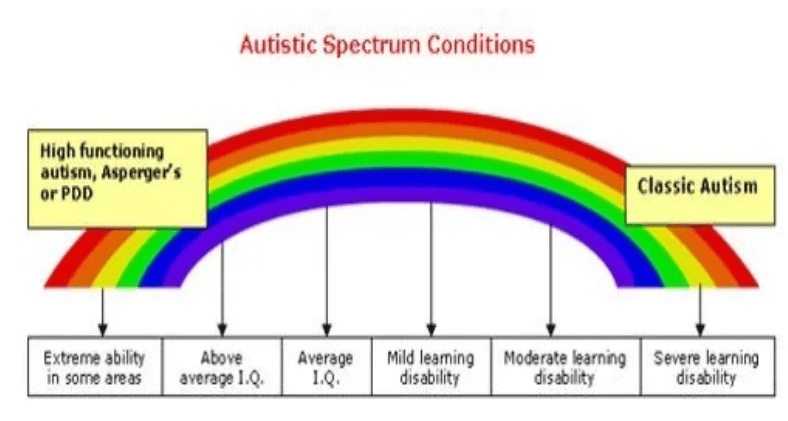
The problem with this viewpoint was that this model was overly simplistic. Nobody, including yours truly, is entirely “high functioning” or “moderate” or “severe” in all areas.
By way of example, in the 1988 movie, “The Rain Man,” a self-centered car dealer named Charlie Babbitt (Tom Cruise) discovered that his estranged father had passed away and had left his multi-million dollar estate to a (previously unknown) older brother, Raymond Babbitt (played by Dustin Hoffman). Although Raymond was an institutionalized man with autism, he was also a mathematical savant.
Charlie subsequently used his brother’s ability to count cards while playing blackjack at a Las Vegas casino.

A Better Model for Autism
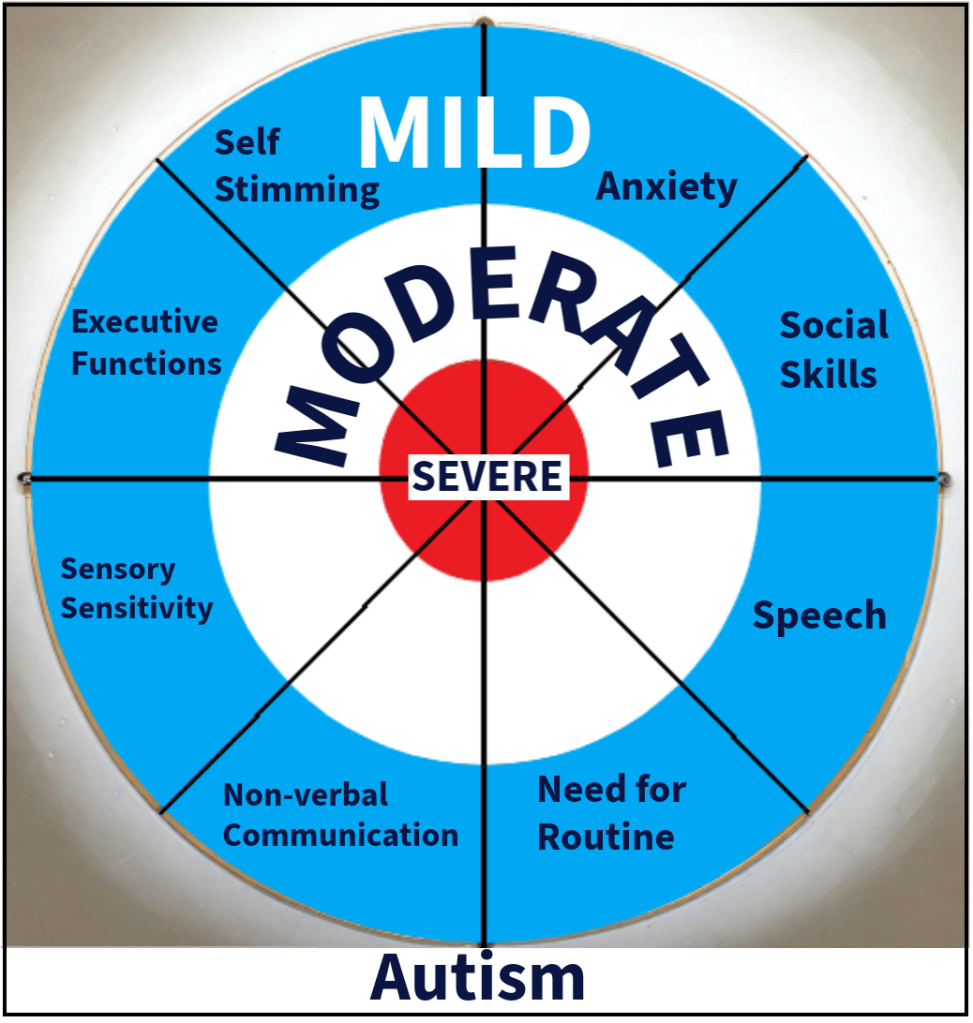
While a rainbow captures the broad diversity of autistic traits across different people, a “layered onion” better explains how visible behaviors are built over deeper, unseen neurological and emotional layers within each person.
For example, when I was a teacher, I had superior levels of executive functioning. I could multi-task, manage time, plan and organize lessons, stay patient while interacting with students, evaluate and document student progress, and react appropriately to changing circumstances.
In contrast, my social skills have always been limited. My literal mindset can make it difficult for me to understand some aspects of humor and sarcasm. I am not good with idle chit-chat. Although I have the ability to make eye contact, doing so makes me acutely uncomfortable.
When I was much younger, I had challenges with moderating the volume of my voice. I sometimes spoke too loudly or too softly. It took me decades of experience before I began to understand the give and take of interpersonal communication. It has not helped that I have prosopagnosia, (facial blindness), a neurological condition that makes it difficult for me to recognize people by looking at their facial features.
In addition to not always understanding who I am speaking to, as with many people on the spectrum, I am not particularly good at understanding tones of voice or reading facial expressions and body language.
Since up to 70% of what neurotypical people say is communicated through non-verbal means; having prosopagnosia as well as a literal mindset can make it extraordinarly difficult for me to interact with others. Although I had superior abilities within the area of executive functioning, my social skills have always been wanting.
It is for this reason that a model of autism is better described as a layered onion with varying abilities across various competencies.
Do you agree with my premise that autism is more like a layered onion rather than a rainbow? Please share your thoughts.




Leave a Reply